
Project
BioSupPack
Upgrading the production and enzymatic recycling of environmentally friendly PHA-based rigid packaging solutions, using beer spent grains as feedstock units
The growing use of bioplastics in packaging is driven by the ongoing demand for sustainable products from both consumers and brands, in response to the rising awareness of environmental impact and the need to reduce reliance on fossil resources. Innovations in the bioplastics industry have increased the number of manufacturers and end users, with new biopolymers such as polyhydroxyalkanoates (PHA) exhibiting high growth rates. Global PHA production is expected to increase substantially in the coming years.
PHAs are 100% bio-based, biodegradable in various environments, recyclable, and possess a wide range of physical and mechanical properties. This makes them suitable for packaging applications as an alternative to conventional fossil-based plastics. However, further improvements are needed to offer cost-effective solutions with adequate performance for demanding packaging applications and sustainable end-of-life options.
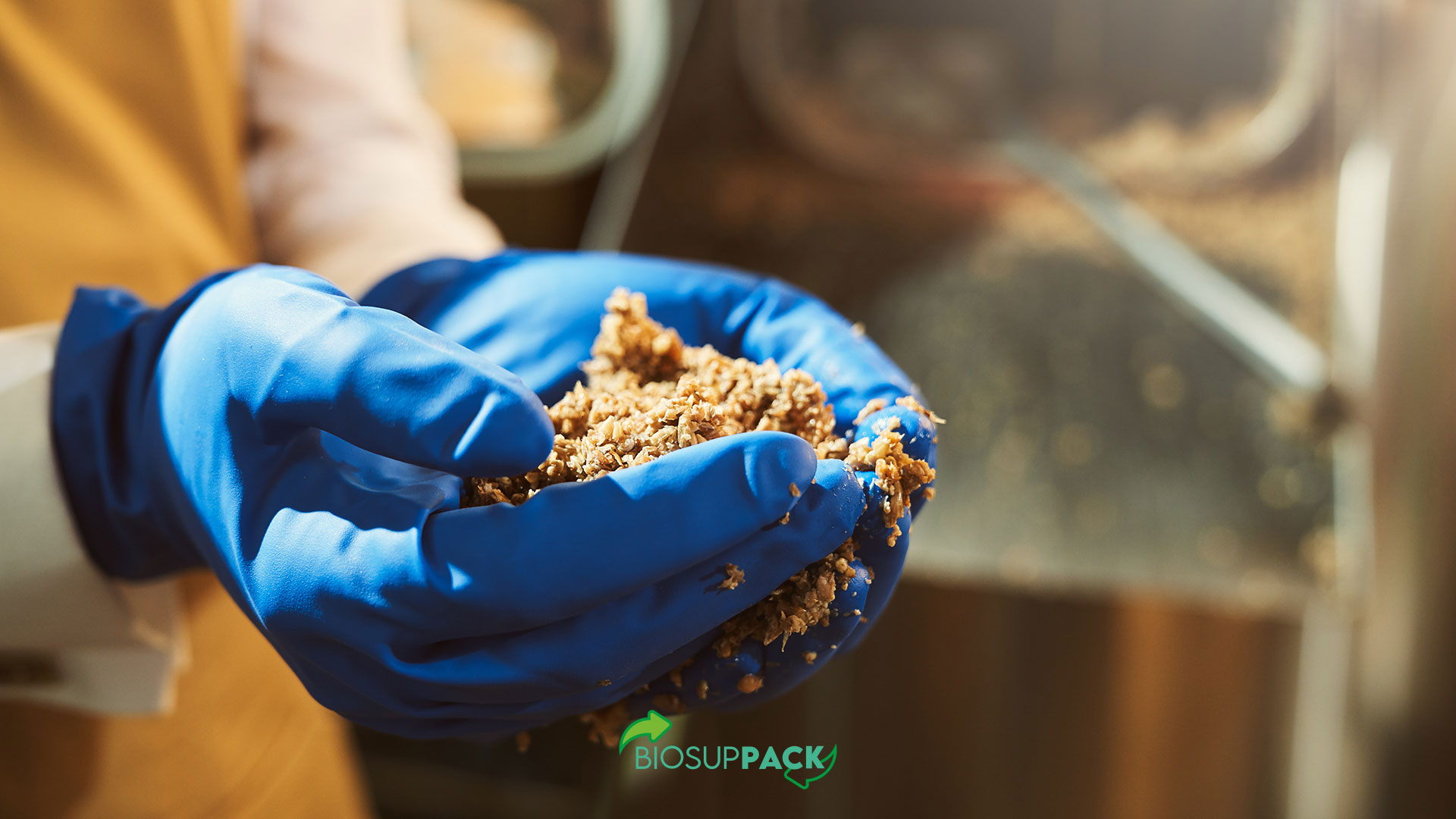
Brewers’ spent grain (BSG) — the most abundant byproduct of the brewing industry — is produced in large volumes and is available at low or zero cost. Currently, its usage is mostly restricted to livestock feed, bioethanol production, or disposal in landfills. Despite challenges such as high moisture content and low fermentable sugar levels, BSG is a promising feedstock for PHA production. Advantages include year-round availability, stable composition, and the efficient isolation of second-generation sugars.
The BioSupPack strategy and innovations are designed to overcome these barriers and deliver new packaging solutions that meet end-user needs, comply with European sustainability policies, and encourage a circular plastics economy.
Main Goal
BioSupPack aims to provide new, cost-competitive, flexible, and eco-friendly PHA-based packaging solutions with high performance for food, cosmetic, household, and beverage applications, as well as zero environmental harm during and after use.
Specific Project Objectives
- Optimize PHA-based formulations with over 85% w/w renewable content.
- Scale up multiple conversion processes, as well as the sorting and recycling of post-consumer waste, applying advanced Industry 4.0 approaches.
- Expand the range of rigid packaging applications by customizing bio-based materials and packaging properties via formulation optimization combined with plasma technology or graft-based coatings.
- Integrate plasma technology at three different points in the value chain (pre-treatment of biomass, packaging production, and pre-treatment of packaging waste).
- Demonstrate enhanced recyclability by: i) Installing a real-time monitoring system for selective separation of the new packaging after use, and ii) mechanically recycling industrial scrap and selectively using enzymatic recycling for post-consumer packaging.
- Establish a new value chain including logistics development and the management of both brewing waste and packaging.
By addressing industry needs (cost/performance competitiveness versus non-biodegradable fossil-based equivalents and regulatory compliance) and rising consumer awareness, BioSupPack will have a considerable impact on the EU bioplastics and end-user sectors, on biorefineries and biotech industries, and on society at large.

BioSupPack
Upgrading the production and enzymatic recycling of environmentally friendly PHA-based rigid packaging solutions, using beer spent grains as feedstock units
The growing use of bioplastics in packaging is driven by the ongoing demand for sustainable products from both consumers and brands, in response to the rising awareness of environmental impact and the need to reduce reliance on fossil resources. Innovations in the bioplastics industry have increased the number of manufacturers and end users, with new biopolymers such as polyhydroxyalkanoates (PHA) exhibiting high growth rates. Global PHA production is expected to increase substantially in the coming years.
PHAs are 100% bio-based, biodegradable in various environments, recyclable, and possess a wide range of physical and mechanical properties. This makes them suitable for packaging applications as an alternative to conventional fossil-based plastics. However, further improvements are needed to offer cost-effective solutions with adequate performance for demanding packaging applications and sustainable end-of-life options.
Brewers’ spent grain (BSG) — the most abundant byproduct of the brewing industry — is produced in large volumes and is available at low or zero cost. Currently, its usage is mostly restricted to livestock feed, bioethanol production, or disposal in landfills. Despite challenges such as high moisture content and low fermentable sugar levels, BSG is a promising feedstock for PHA production. Advantages include year-round availability, stable composition, and the efficient isolation of second-generation sugars.
The BioSupPack strategy and innovations are designed to overcome these barriers and deliver new packaging solutions that meet end-user needs, comply with European sustainability policies, and encourage a circular plastics economy.
Main Goal
BioSupPack aims to provide new, cost-competitive, flexible, and eco-friendly PHA-based packaging solutions with high performance for food, cosmetic, household, and beverage applications, as well as zero environmental harm during and after use.
Specific Project Objectives
- Optimize PHA-based formulations with over 85% w/w renewable content.
- Scale up multiple conversion processes, as well as the sorting and recycling of post-consumer waste, applying advanced Industry 4.0 approaches.
- Expand the range of rigid packaging applications by customizing bio-based materials and packaging properties via formulation optimization combined with plasma technology or graft-based coatings.
- Integrate plasma technology at three different points in the value chain (pre-treatment of biomass, packaging production, and pre-treatment of packaging waste).
- Demonstrate enhanced recyclability by: i) Installing a real-time monitoring system for selective separation of the new packaging after use, and ii) mechanically recycling industrial scrap and selectively using enzymatic recycling for post-consumer packaging.
- Establish a new value chain including logistics development and the management of both brewing waste and packaging.
By addressing industry needs (cost/performance competitiveness versus non-biodegradable fossil-based equivalents and regulatory compliance) and rising consumer awareness, BioSupPack will have a considerable impact on the EU bioplastics and end-user sectors, on biorefineries and biotech industries, and on society at large.